
- HOME
- OPINION
- ON GROUND
- INTERVIEW
- Neta Profile
- Editor's Pick
- INDIA
- NewsGram USA
- WORLD
- न्यूजग्राम
- POLITICS
- ENTERTAINMENT
- CULTURE
- LIFESTYLE
- ECONOMY
- SPORTS
- Jobs / Internships
- Misc.
- NewsGram Exclusive

Madras High Court upheld the lighting of the Karthigai Deepam lamp atop Thiruparankundram hill near Madurai.
Appeals by the Tamil Nadu government, Waqf Board and dargah were dismissed as lacking legal merit.
Lamp lighting will take place under ASI safeguards with limited access and district administration supervision.
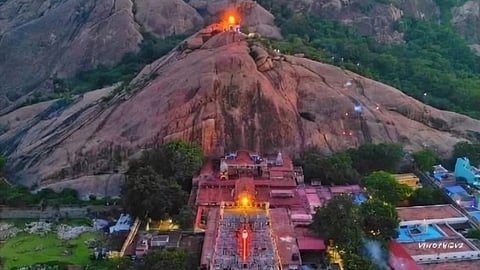
The Madras High Court upheld a single-judge order permitting the lighting of a ceremonial lamp atop the Thiruparankundram hill near Madurai during the Karthigai Deepam festival on Tuesday, 6 January 2026. The ceremonial lamp is lit at a stone pillar called Deepathoon, located within the premises of the shrine. The appeal filed by the Tamil Nadu government, the Tamil Nadu Waqf Board, and the Sikkandar Badhusha dargah was dismissed by a Division Bench of Justices G. Jayachandran and K.K. Ramakrishnan. The Bench held that there was no legal or religious bar to the practice and that apprehensions of law and order disturbances were unfounded.
The Bench directed the Arulmigu Subramania Swamy Temple Devasthanam to proceed with the ritual of lighting the lamp. However, it also stated the condition that only a limited temple team would be allowed on the hill under the supervision of the district administration. Conditions laid down by the Archaeological Survey of India (ASI) will also be imposed to ensure the protection of the monuments on the hill. The general public will not be allowed to accompany the temple representatives, as per the instructions. The Bench also directed the District Collector to coordinate and oversee the event.
The Court further added that the appellants failed to produce any “formidable evidence” that could establish a prohibition under the Agama Shastras against lighting a lamp at a location other than directly above the sanctum sanctorum. It also pointed out that the lighting of the deepam at Thiruparankundram hill was neither opposed by the Devasthanam nor by the State as a customary practice.
The Bench also rejected the State’s concerns regarding potential disturbances to public peace, calling them “ridiculous and hard to believe.” It clarified that if allowing temple representatives to light a lamp on temple land could disrupt law and order, then such disturbances would likely be “sponsored by the State itself.” It further observed that such misgivings could create an “imaginary ghost” that would foster distrust between communities.
The Waqf Board’s submission claiming that the stone pillar belonged to the dargah met with sharp criticism from the Division Bench, which termed it “mischievous.” The Court clearly stated that the pillar was undoubtedly a Deepathoon situated on land declared as the property of the temple Devasthanam by a competent civil court. It ruled that the Waqf Board had no say in the matter.
The Court also held that lighting the lamp at an elevated place enables devotees at the foothills to witness and worship, highlighting the symbolic and practical reasons behind the religious practice. It further added that there was no plausible reason for temple authorities to deny devotees’ request to perform such a customary practice that has long existed.
The case arose from a challenge to the judgment of single-judge Justice G.R. Swaminathan, who had directed the restoration of the practice of lighting the Karthigai Deepam at the designated stone pillar atop the hill, in addition to the existing ritual at the Ucchi Pillayar temple. Justice Swaminathan also held that the practice did not violate the rights of the nearby Muslim shrine.
The single judge had further observed that while some portions of the hill belonged to the dargah, the location of the Deepathoon belonged to the temple, based on a civil court judgment from the 1920s. However, the age-old custom was disallowed by a court ruling in 2014, leading to devotees being prevented from lighting the lamp during the 2025 Karthigai Deepam festival by local authorities, who cited concerns over public order. This then prompted the filing of a contempt petition, which remains pending before the single judge.
During the proceedings, the Advocate General argued that there was no established tradition of lighting the pillar and suggested that the issue be examined under Section 63 of the Hindu Religious and Charitable Endowments (HR&CE) Act. This argument was rejected by the Bench, which held that Section 63 did not provide an effective alternative remedy in the present case. The Court also took note of objections raised by Hindu devotees regarding undue delay and erosion of their rights, and accordingly declined suggestions of mediation.
Emphasising peaceful coexistence, the Court observed that “everyone should have freedom of religion without disturbing the other.” The Bench added that the guidelines issued would enable both Hindu and Muslim communities to celebrate their respective festivals at the hill without disturbance, reiterating that the Constitution and natural resources belong to all.
(Edited by Dhruv Sharma)
Suggested Reading:
Subscribe to our channels on YouTube and WhatsApp
Download our app on Play Store
