
- HOME
- OPINION
- ON GROUND
- INTERVIEW
- Neta Profile
- Editor's Pick
- INDIA
- NewsGram USA
- WORLD
- न्यूजग्राम
- POLITICS
- ENTERTAINMENT
- CULTURE
- LIFESTYLE
- ECONOMY
- SPORTS
- Jobs / Internships
- Misc.
- NewsGram Exclusive
Owaisi and Humayun Kabir’s pre-poll alliance ended after a controversial video, with AIMIM withdrawing support.
The break-up has created confusion among Muslim voters, potentially dividing votes between AIMIM, Kabir, and TMC.
The split could benefit BJP if TMC’s vote bank weakens, while Mamata Banerjee is trying to consolidate support through Bengali identity politics.
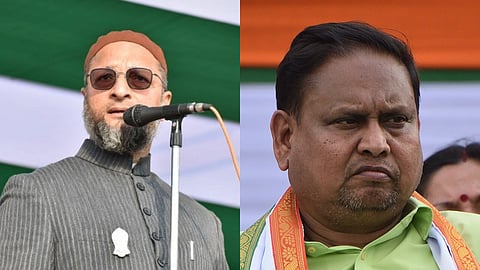
The political landscape of West Bengal is intense, marked by sharp political statements, violence, and aggressive campaigning. Asaduddin Owaisi and Humayun Kabir have added a new twist to the ongoing political battle. Initially, Owaisi and Kabir decided to form an alliance and contest the 2026 Assembly elections together. They announced their partnership in Hyderabad on March 22, 2026, which led to speculation that they could attract a significant share of Muslim voters in the state. However, this alliance did not last long.
The alliance quickly became a major talking point in Bengal politics. Kabir had already been in the spotlight after laying the foundation stone of a mosque modeled on the Babri Masjid in Murshidabad on December 6, 2025. His statements and actions were seen by many as contributing to religious polarization. Owaisi supported Kabir at the time, and together they appeared to be building a strong Muslim political front.
However, the alliance soon collapsed. On April 9, 2026, the ruling party led by Mamata Banerjee released a video allegedly showing Humayun Kabir making controversial claims, including that he had taken money from the BJP to influence Muslim voters. In a post along with the video, the TMC said, “Humayun Kabir, the face of provocation, has been caught red-handed in a sting operation, admitting he took money from BJP to deliberately incite communal tension in Bengal… Bengal will never tolerate those who try to divide us from within. We reject this poisonous politics completely.”
Kabir denied the video, calling it AI-generated, and said he would file a defamation case. However, the damage was immediate. The very next day, on April 10, 2026, Owaisi announced that his party, AIMIM, was ending its alliance with Kabir’s Aam Janata Unnayan Party (AJUP).
In a public statement, AIMIM said it could not be associated with remarks that questioned the integrity of Muslims and announced that it would contest the elections independently. In a post on X, the party stated, “Humayun Kabir's revelations have shown how vulnerable Bengal's Muslims are. AIMIM cannot associate with any statements where the integrity of Muslims is brought into question. As of today, AIMIM has withdrawn its alliance with Kabir's party.” The party also emphasized that its goal is to give marginalized communities an independent political voice, marking a clear break from their earlier strategy.
The political impact of this split is significant. Earlier, many Muslim voters were beginning to see the Owaisi-Kabir alliance as a united front, which could have weakened the Trinamool Congress (TMC), especially in districts like Murshidabad. With the alliance now broken, Muslim voters appear divided and uncertain about whom to support.
AIMIM has announced that it will contest only 11 seats in the state, while Humayun Kabir plans to field candidates in around 149 seats and is himself contesting from Rejinagar and Nawada. At the same time, Mamata Banerjee is trying to turn the situation in her favor by appealing to voters in the name of Bengali identity. The TMC had long been trying to weaken the alliance between Owaisi and Kabir, and the recent split appears to have worked in its favor.
As West Bengal heads into elections for its 294-member Assembly, scheduled in two phases on April 23 and April 29, with counting on May 4, the political landscape has become more complex. Whether the split will help the BJP or allow the TMC to consolidate its support will largely depend on how voters, especially Muslim voters, respond to this evolving political situation.
(Edited by Dhruv Sharma)
Suggested Reading:
Subscribe to our channels on YouTube and WhatsApp
Download our app on Play Store


