
- HOME
- OPINION
- ON GROUND
- INTERVIEW
- Neta Profile
- Editor's Pick
- INDIA
- NewsGram USA
- WORLD
- न्यूजग्राम
- POLITICS
- ENTERTAINMENT
- CULTURE
- LIFESTYLE
- ECONOMY
- SPORTS
- Jobs / Internships
- Misc.
- NewsGram Exclusive

AI generated summary, newsroom-reviewed
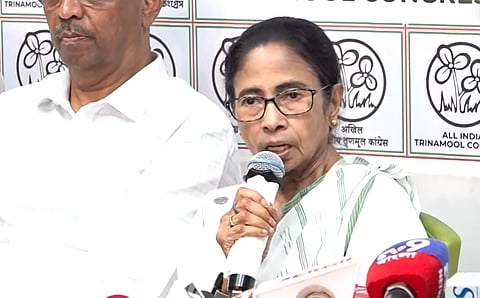
After 15 years of the Trinamool Congress’s rule in West Bengal, Mamata Banerjee, the ‘didi’ who has personified both the state and its politics, faced a decisive defeat in the assembly election. The politician lost not only her constituency turf of Bhabanipur but also her party’s majority in the state. However, the very next day after the results were declared, on May 5th 2026, Mamata held a press conference in Kolkata firmly declaring that she won't be stepping down as West Bengal’s chief minister.
Rather than adopting the stance of a grateful defeat, the CM instead refused to accept her defeat in the polls, remarking that the BJP ‘stole’ the election and claiming their victory was the result of a ‘conspiracy’ against the people’s mandate.
She also accused the Election Commission (EC) and the BJP of ‘forcefully capturing’ the elections in Bengal.
Directing her ire towards the Central Reserve Police Force (CRPF) and the EC, the outgoing CM accused them of colluding with the BJP and ensuring TMC’s defeat. She further alleged that despite being legally permitted to access counting centers, she along with other TMC members were barred from doing so.
Taking the allegations further, Banerjee accused that her workers were physically assaulted by the CRPF and BJP during the election season. She also threatened taking action against the EC.
One of the most explosive moments of the conference came when Banerjee firmly held that she will not be resigning from the post of Chief Minister. "I have not lost, so I will not go to Raj Bhavan. I will not tender resignation,” she stated.
The outgoing CM says dialogue with other INDIA bloc leaders would be held to decide upon a plan of action consequent to the election defeat. Banerjee appears determined to challenge the election results and is likely to approach the courts against the Election Commission. She and other INDIA bloc leaders may also organise a statewide protest against the EC.
However, these are merely speculated scenarios, as no official statement has been issued by her or the Trinamool Congress so far.
If Mamata Banerjee does not tender her resignation of the CM post, it still wouldn't bar the winning BJP party from coming into power and installing their new Chief minister in West Bengal.
In the assembly election 2026, the BJP scored a major victory within the state, winning 207 seats as the TMC lagged behind with 80 seats. As the BJP secures a clear majority, Banerjee refusing to resign does not allow her to continue in power indefinitely. Without majority support in the Assembly, she can be removed from office.
Under Article 164 of the Constitution of India, a Chief Minister holds office only as long as they enjoy the confidence of the Legislative Assembly. Once that confidence is lost, the government becomes constitutionally untenable. In such a scenario, the Governor of West Bengal can dismiss Mamata Banerjee and her Council of Ministers and invite the BJP to form the new government.
S.Y. Qureshi, former Chief Election Commissioner (CEC), says that in scenarios like this one wherein an outgoing CM refuses to vacate their seat, the governor of the state is constitutionally empowered to ask for the CM’s resignation. If the procurement of the request fails, the governor can invoke Article 356, known as the President’s Rule, citing a breaking of the state’s constitutionary machinery.
Quraishi pointed out that the Constitution does not contain any specific provision for a due process if an incumbent Chief Minister refuses to vacate the post.
He emphasised that, as per the Constitution, a Chief Minister can remain in office only as long as they enjoy the confidence of the Legislative Assembly. With the TMC winning just 80 seats against the BJP’s 207, it is clear that the ruling party has lost the confidence of the House to continue in power.
A senior advocate of the Supreme Court, Sunil Fernandes, says that Banerjee stands to gain nothing by this refusal. “She [Mamata] will achieve nothing by resisting. By resisting her resignation she will only contribute to constitutional chaos,” Fernandes said.
In such a situation, the responsibility shifts to the Governor to dismiss the outgoing Chief Minister and invite the party with the majority to form the new government.
Senior advocate of the Calcutta High Court, Jayanta Narayan Chatterjee, said, “Since Independence we have never seen anything like this. No chief minister has refused to step down.”
Suggested reading:
Subscribe to our channels on YouTube and WhatsApp
Download our app on Play Store
