
- HOME
- OPINION
- ON GROUND
- INTERVIEW
- Neta Profile
- Editor's Pick
- INDIA
- NewsGram USA
- WORLD
- न्यूजग्राम
- POLITICS
- ENTERTAINMENT
- CULTURE
- LIFESTYLE
- ECONOMY
- SPORTS
- Jobs / Internships
- Misc.
- NewsGram Exclusive

Key Points:
A suicide bombing at the Khadijatul Kubra mosque-cum-imambargah (a Shia Mosque) in Islamabad’s Tarlai area during Friday prayers killed at least 31 people and injured over 170 others.
Initial investigations linked the bomber to Fitna al Khwaraji or Tehreek-e-Taliban Pakistan, with arrests made in Islamabad and near the Pakistan-Afghanistan border. India’s Ministry of External Affairs condemned the attack and rejected Pakistan’s allegations of cross-border involvement as baseless.
The Islamic State reportedly claimed responsibility, with international media citing Amaq News Agency saying the Islamic State in Pakistan carried out the attack. The group stated the Shia community in Pakistan was a “human reservoir,” providing shia militants to fight against ISIS in Syria.
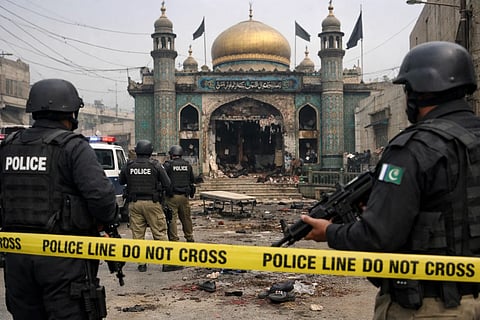
A suicide bombing in Pakistan’s Islamabad on Friday, February 6, 2026, has claimed at least 31 lives and injured over 170 people. The blast occurred at the Khadijatul Kubra mosque-cum-imambargah (a Shia Mosque) in Islamabad’s Tarlai area during Friday (Jumma) prayers. The Pakistani Police have reported that the bomber exploded himself after opening fire on security forces, when stopped at the entrance gate. The attack is claimed to be one of the deadliest attacks in over a decade in Pakistan's capital.
The Pakistani Police cordoned off the area following the bombing, and the security forces launched rescue operations. Authorities declared a statewide emergency, conducting investigations into the incident.
The Islamic State (ISIS) has reportedly claimed responsibility for the attack. Multiple international media agencies, citing Amaq News Agency (ISIS’s official propaganda news channel claiming responsibility for several terrorist attacks worldwide) have reported that the Islamic State in Pakistan (ISIS affiliate in Pakistan) carried out the attack.
The Islamic State reportedly stated that the Shia community in Pakistan was like a human reservoir, providing recruits to Shia militias fighting against ISIS in Syria. Indian Shia residents in Jammu and Kashmir’s Baramullah district protested against the bombing on February 7, 2026, raising slogans against Pakistan's government and Pakistan’s state sponsored terrorism. “Humkuat-e-Pakistan Murdabad, Hindustan Zindabad……. (Pakistan Down Down, Long Live Hindustan), shouted the residents condemning the atrocities committed by Pakistan.
The Pakistani Police reported on February 6, 2026, that initial investigations revealed that the suicide bomber was a foreign national having connections with Fitna al Khwaraji, a term synonymous with Tehreek-e-Taliban Pakistan (TTP), a jihadist terrorist organisation operating primarily along the Afghanistan–Pakistan border. The Pakistani Police on Saturday, February 6, 2026, stated that the suicide bomber was a Pakistani national who had frequently travelled to Afghanistan.
Pakistani authorities have also said that multiple suspects were arrested following overnight raids in Islamabad and in northwestern Pakistan, close to the Pakistan-Afghanistan border.The arrested suspects include the brother, mother and other relatives of the bomber, with further investigation and possible arrests ongoing, said the Police.
Following the attack, Pakistan had claimed that the attack was linked to Afghanistan. Pakistan’s Defence Minister Khwaja Asif said on February 6, 2026, that the attacker was involved in cross border militant connections, hinting at Afghanistan and India. Khaama Press News Agency, an online news agency based in Afghanistan reported on February 6, 2026, that Taliban officials in Afghanistan rejected Pakistan’s claim, calling the allegations premature and unsupported by evidence.
Responding to Pakistan’s claims of blaming others and issuing an official statement on the attack in Islamabad, India’s Ministry of External Affairs called the incident tragic and condemned the attack.
The official statement issued by the MEA on February 6, 2026, states: “The bombing at an Islamabad mosque earlier today is condemnable and India condoles the loss of life it has caused. It is unfortunate that, instead of seriously addressing the problems plaguing its social fabric, Pakistan should choose to delude itself by blaming others for its home-grown ills. India rejects any and every such allegation, which is baseless as it is pointless.”
The Islamabad bombing underscores how Pakistan’s deep-rooted governance failures continue to fuel a cycle of violence and denial. Instead of confronting home-grown threats and containing cross border terrorism, Pakistan’s reflex to deflect blame outward only worsens regional instability, exporting insecurity to neighbouring countries and undermining prospects for peace. Until the state dismantles its terror ecosystem and restores systemic accountability, such attacks will remain a grim reminder of the cost of failed governance, both for Pakistan and for South Asia at large.
(Edited by Dhruv Sharma)
Suggested Reading:
Subscribe to our channels on YouTube and WhatsApp
Download our app on Play Store
