
- HOME
- OPINION
- ON GROUND
- INTERVIEW
- Neta Profile
- Editor's Pick
- INDIA
- NewsGram USA
- WORLD
- न्यूजग्राम
- POLITICS
- ENTERTAINMENT
- CULTURE
- LIFESTYLE
- ECONOMY
- SPORTS
- Jobs / Internships
- Misc.
- NewsGram Exclusive

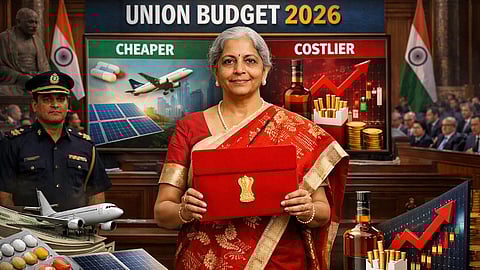
Union Budget 2026 lowers costs for healthcare, clean energy, agriculture, aviation and overseas travel through duty exemptions and TCS cuts.
Taxes and duties rise on tobacco, select imports, market trades and misreported income to tighten compliance and discourage non-essential use.
The Budget prioritizes growth and reforms, supporting key sectors while offering no major relief to individual income taxpayers.
Finance minister Nirmala Sitharaman presented her ninth consecutive Union Budget in Parliament on Sunday, 1 February 2026. She highlighted the economic priorities which would be considered by the government in the upcoming year. The Finance Minister directed that the budget would be focusing on faster economic growth, inclusive development and continued structural reforms which she termed as the three guiding “kartavyas” or crore responsibilities. This would take into account the broader “sankalp” that will centre around the poor, underprivileged and disadvantaged sections of society.
The Budget introduced several changes across key sectors which would result in reducing cost in healthcare, renewable energy, agriculture, and exports. Several goods are set to become cheaper while others are set to cost more owing to a mixture of duty exemptions, tax rate revisions and changes in tax collection at source (TCS).
The budget has extended a significant relief to overseas travelers and families sending money abroad as TCS on overseas tour packages has been reduced from 5-20 percent to 2 percent. As per the Liberalised Remittance Scheme (LRS), TCS on overseas education and medical remittances would also be lowered from 5 percent to 2 percent.
Duty-free import benefits would be allocated to shoe upper exports along with fully exempting basic custom duty (BCD) from energy transition equipment, solar glass ingredients, capital goods for critical minerals and battery energy storage. The aviation sector would also be subjected to lower operational costs as the components and parts used in the maintenance and repair of civilian aircraft have also been exempted from BCD which would result in a boost to exports and manufacturing.
The budget showcased remarkable relief to healthcare by exempting basic customs duty on drugs used in the treatment of cancer and rare diseases. Duty exemption has also been granted to the goods used in nuclear power projects and the fish caught by Indian fishermen.
Consumers would also be getting cheaper as the basic customs duty on microwave ovens and all dutiable personal-use imports has been reduced from 20 per cent to 10 per cent. The government is promoting cleaner fuel adoption by exempting bio-gas blended compressed natural gas (CNG) from central excise duty.
Makhana and roasted nuts also saw a sharp decrease in import duties from 150 percent to 30 percent along with duty reductions on almonds and walnuts, providing relief to the agriculture and food sector. The seeds and spores used for sowing would also be subjected to a reduced 15 percent BCD, which was earlier at 30 percent. In addition, turkey meat and feed for prawns and shrimp also saw reduced duties.
Minerals crucial for manufacturing and clean energy transition along with key industrial inputs got cheaper with duties being reduced on natural graphite, quartz, coal, lignite and peat. Similarly, duties were completely exempted from natural sand, silicon, rare-earth metals and strontium sulphate.
BCD was reduced from 7.5 percent to 5 percent for phosphoric acid whereas several metal oxides and compounds used in batteries and electronics were cut to zero duty. The leather industry also comes in the list as wet blue leather imports were made duty-free.
Input costs for refineries was eased by shifting the 5 per cent ad valorem duty on petroleum crude to a nominal Re 1 per tonne.
There were also other sectors which saw an increase in the costs with the budget 2026 showcasing an increase in the income tax misreporting penalties. Now, violators will be facing a penalty of 100 percent of the tax amount adding tax and interest to it.
Securities Transaction Tax (STT) on stock options were increased to 0.15 percent, making the market-related transactions more expensive. STT on futures trading also saw a jump from 0.02 percent to 0.05 percent.
Alcoholic liquor, sale of minerals and scrap would be leading to higher prices downstream with the government increasing TCS from 1 percent to 2 percent. National Calamity Contingent Duty (NCCD) on chewing tobacco, jarda scented tobacco and gutkha faced a sharp rise of 60 percent from 25 percent, targeting the sin goods. These products would now be significantly costlier.
There were also duty hikes on import of cranberries, blueberries and related products. Additionally, potassium hydroxide which was earlier not charged will now be subjected to a 7.5 per cent duty. Duty on refrigerated containers will now stand at 5 percent. Meanwhile, floor import price on imports of umbrellas and umbrella parts, comparatively raising the costs.
Union Budget 2026 can be summarized to be regulating manufacturing, exports, clean energy and healthcare through blending tax reliefs and duty hikes, essentially discouraging non-essential imports and tightening tax compliance.
Suggested Reading:
Subscribe to our channels on YouTube and WhatsApp
Download our app on Play Store
