- HOME
- OPINION
- ON GROUND
- INTERVIEW
- Neta Profile
- Editor's Pick
- INDIA
- NewsGram USA
- WORLD
- न्यूजग्राम
- POLITICS
- ENTERTAINMENT
- CULTURE
- LIFESTYLE
- ECONOMY
- SPORTS
- Jobs / Internships
- Misc.
- NewsGram Exclusive

Assembly Elections in 2026 are set be contested across four states – Keralam, Assam, West Bengal and Tamil Nadu – and one Union Territory – Puducherry – in two phases. After Bihar, these are the first states heading to elections following the contentious nationwide Special Intensive Revision (SIR) of electoral rolls, which saw crores of names removed from the voter list across the Assemblies.
Phase 1 will see Keralam, Assam and Puducherry go to polls on 9 April 2026. A total of 296 seats are up for voting across the three regions, including 140 in Keralam, 126 in Assam, and 30 in Puducherry. Counting of votes and announcement of the results for both phases will take place on 4 May 2026.
This follows weeks of intense campaigning and sharp political exchanges across all three regions, with election officials completing final preparations, distributing electronic voting machines, and deploying security personnel to ensure smooth polling.
The elections are being closely watched due to leadership battles in Keralam, high profile contests in Assam, and heightened enforcement of poll norms in Puducherry.
Keralam: An Ideological Battle
71 seats are required to form a majority in the Keralam Assembly. The election has emerged as a decisive contest for all three major political fronts, with stakes unusually high for the ruling Left Democratic Front (LDF), the Congress-led United Democratic Front (UDF), and the BJP-led National Democratic Alliance (NDA).
For the Congress and the UDF, the election is widely seen as a survival test. The alliance has remained out of power for a decade, and another defeat could trigger organisational instability and strain within the alliance. Leader of the Opposition VD Satheesan has raised the stakes further by indicating he would step away from politics if the UDF loses the election. The Indian Union Muslim League, the second largest party in the UDF, is also closely watching the outcome as the alliance attempts to return to power after a prolonged period in opposition.
The CPI(M)-led Left Democratic Front faces a critical moment. Despite being in power, the alliance has suffered setbacks in recent Assembly bypolls, Lok Sabha elections, and local body polls. The upcoming election is therefore being viewed as a test of the Left’s ability to retain its core voter base and maintain organisational cohesion. A defeat would be particularly significant as Keralam remains the only state currently governed by the Left, and any loss could weaken the broader national communist movement.
Chief Minister Pinarayi Vijayan has emerged as the central figure in the LDF campaign, with the alliance projecting his leadership and governance record. The CPI(M) leadership has invested heavily in his image as a crisis manager and administrator. As a result, the election outcome is likely to be interpreted as a direct verdict on his leadership.
On the other side, VD Satheesan has emerged as the principal challenger, with Congress supporters positioning him as a counterweight to Vijayan. The UDF’s main strategy focuses on instances of misgovernance by the LDF, decreasing popularity of the CPI(M) and assertions that the alliance has drifted from its original ideology. The contest between the two leaders has shaped much of the campaign narrative, with both portrayed as decisive and strong administrators.
For the BJP led National Democratic Alliance, the stakes differ. The alliance has experienced a slump in vote share in earlier local body elections despite a brief uptick during the 2024 Lok Sabha Elections. The party’s main strategy revolves around a handful of key seats where its candidates performed strongly. A weak performance could slow the BJP’s expansion efforts in Keralam, while a strong showing could mark a turning point in the state's electoral dynamics.
Welfare initiatives dominated campaign narratives, while development issues received relatively limited focus. Defections from the Left and the Sabarimala issue featured in early campaign discussions. In later stages, the proposed amendments to the Foreign Contribution Regulation framework became a talking point in central Keralam, placing the BJP on the defensive. The Congress also highlighted its promise to build houses for victims of the Wayanad landslides in the final phase of campaigning.
Assam: High Rhetoric, High Stakes
64 seats are required to form a majority in the Assam Assembly. The election has drawn attention due to shifting alliances, defections, intense rhetoric, and high profile leadership battles between the BJP-led North East Democratic Alliance (NEDA) and the Congress-led Asom Sonmilito Morcha (ASM). All India United Democratic Front is another major player contesting in the election.
Two constituencies in particular, Dispur and Jorhat, have emerged as key battlegrounds.
In Dispur, the contest has turned into a three-way fight shaped by defections and internal rivalries. Pradyut Bordoloi, a former Congress MP from Nagaon, is contesting on a BJP ticket after joining the party in March 2026. He cited humiliation and marginalisation within the Congress as reasons for switching sides.
His main challenger is Jayant Kumar Das, a former BJP leader who resigned after being denied a ticket and is now contesting as an independent candidate. The Congress has fielded Mira Borthakur Goswami, completing the three cornered contest in what was once considered a Congress stronghold.
Jorhat has also become a focal point, with Assam Pradesh Congress Committee president Gaurav Gogoi contesting against BJP incumbent Hitendra Nath Goswami. Gogoi, a three time MP and son of former Chief Minister Tarun Gogoi, is contesting his first Assembly election. The contest has taken on added significance as Congress attempts to challenge the BJP’s rule in the state.
Beyond individual seats, Upper Assam and North Assam remain crucial to the electoral outcome. In the previous Assembly election, the BJP led NDA secured 39 of the 49 seats in the region, while the Congress led alliance won nine. One seat was won by Raijor Dal, which contested alongside Assam Jatiya Parishad as part of a third front. Both parties emerged from anti-CAA protests.
Political equations in Upper Assam have shifted since the previous election, with districts including Lakhimpur, Dhemaji, Golaghat, Jorhat, Majuli, Charaideo, Sivasagar, Dibrugarh, and Tinsukia becoming central to the contest. The ASM is attempting to consolidate support by positioning Gaurav Gogoi as a chief ministerial face and appealing to regional identity.
The run-up to the election has been marked by sharp exchanges between Gaurav Gogoi and Chief Minister Himanta Biswa Sarma. Sarma alleged links between Gogoi, his British wife Elizabeth Colburn Gogoi, and a Pakistani national, citing findings from a Special Investigation Team. Gogoi responded by approaching the Supreme Court, seeking action over the release of personal details of his children.
The Congress also levelled allegations against Sarma and his wife, Riniki Bhuyan Sharma, saying that she holds multiple passports and properties abroad, which he failed to disclose in his candidature affidavit. This was met with a heated response from Sarma and the Assam Police.
Sarma has also faced immense criticism from Opposition leader and civil society organisation for spewing intense anti-Muslim rhetoric in the leadup to the election. While campaigning across the state, Sarma repeatedly targeted Assam’s Bengali-speaking Muslim community – pejoratively referred to as ‘Miyas’ – accusing them of being ‘infiltrators’, advocating for discrimination against them, and threatening legal action against them.
Puducherry: Old Incumbents vs New Faces
17 seats are required to form a majority in the Puducherry Assembly. As with the last state election, the key players are the All India NR Congress (AINRC) and BJP, and the Dravida Munnetra Kazhagam (DMK) and Congress, along with newcomer Tamilga Vettri Kazhagam (TVK) partnering with Neyam Makkal Kazhagam (NMK). This is the electoral debut of actor Vijay’s TVK. Independent candidates also continue to play a significant role, accounting for 117 of the 291 candidates in the fray.
Alliance building in Puducherry remained fluid until the final stages of nominations. The Congress-led Secular Progressive Alliance (SPA) saw uncertainty after the Viduthalai Chiruthaigal Katchi (BCK) initially decided to contest independently in three seats before later reversing its decision and contesting in a single allocated seat. The CPI and CPI(M) are not part of the SPA, further complicating the opposition’s electoral arithmetic. Seat sharing negotiations between the DMK and Congress also remained unresolved until the final day of nominations, with some Congress rebels refusing to withdraw from the race.
On the ruling side, the AINRC-led National Democratic Alliance (NDA) finalised its agreement with only three days before the nomination deadline. A few pro-NDA independent candidates switched sides during the final stages of alliance formation.
Upending historic trends, the TVK is fighting from 28 of 30 total seats, while the NMK is contesting from two.
Past election trends suggest closely contested outcomes. The Congress recorded its poorest performance in 2021, winning just two seats, a sharp decline from its 2016 performance when it secured 15. The BJP, meanwhile, won six seats in 2021, its best performance in the UT. Independent candidates also secured six seats in the previous election, underlining their continued relevance in Puducherry politics.
Margins of victory have also narrowed over time. Around 20% of constituencies in 2021 were won by margins of less than 5% of total votes, indicating the potential for tight contests in the current election. The election is likely to be shaped by local dynamics and tight contests as alliances remain in flux.
Final Preparations Ahead of Polling
With campaigning concluded, election officials in Keralam, Assam, and Puducherry have begun final distribution of electronic voting machines and polling materials. Security forces have conducted briefings, and polling personnel have been dispatched to booths across constituencies. Special squads, patrol teams, and monitoring mechanisms have been deployed to ensure peaceful polling. The Election Commission of India (ECI) has also tightened postal ballot norms, mandating surveillance and enhanced oversight to ensure compliance.
With leadership battles in Keralam, high profile contests in Assam, and intensive enforcement measures in Puducherry, the 9 April polling is set to determine political trajectories across the three regions.
Follow Live Updates of the Phase 1 Polling full day on NewsGram
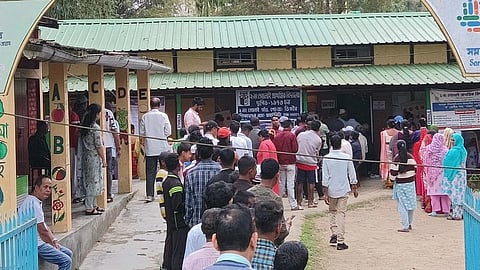
The polling for the high-stakes Assembly elections across Assam, Keralam, and Puducherry has begun, with voters heading out to cast their votes. Prime Minister Narendra Modi took to his official X account to post messages for voters in the respective states.
PM Modi wrote, “As polling begins for the Assam Assembly Elections 2026, I appeal to the people of Assam to exercise their franchise in large numbers. I hope that the state’s youth and women voters participate enthusiastically and make this election a celebration of democracy and public duty.”
In another post, he addressed the voters of Keralam and urged the public to vote in large numbers. He continued, “Record participation will add vigour to Keralam’s democratic spirit. I particularly request the youth and women of the state to step forward and vote in large numbers.”
PM Modi also addressed the people of Puducherry and appealed to the youth and women voters to strengthen the democratic process. He added, “Every vote matters in shaping the future of Puducherry.”
Keralam BJP president Rajeev Chandrasekhar, who is contesting from the Nemom constituency, has cast his vote at a polling station in Thiruvananthapuram. On his way out, he told PTI, urging every voter in Keralam to come out today. He added, “Today, it is their duty and their fundamental right to come and express their opinion on the future of the state.”
Voters arriving to cast their vote at VOC Government School received a grand welcome from a robot named Nila in Puducherry. The robot was seen holding a puja thali in its hands, with flowers on it. Nila was draped in a golden-green saree.
Kaushik from Mirror Robo introduced Nila to ANI and stated that Nila is an event-based robot. “We are coming from Coimbatore. Nila robot has multiple features...It also has a voice feature, and it can talk on its own. We can feed in the command and voice will be audible to the person nearby. She is welcoming the voters here..." said Kaushik
BJP’s Pradyut Bordoloi has cast his vote in the Assam Assembly Elections 2026. Bordoloi, a candidate from the key constituency of Dispur, told the media after casting his vote that he could not transfer his voting rights when he decided to file his nomination as a BJP candidate from Dispur. Bordoloi is a former Congress MP from Nagaon who joined the saffron party on March 18, 2026.
“Since it did not get transferred, I have just cast my vote here now. I am heading back to Dispur..." said Bordoloi.
Chief Minister Pinarayi Vijayan has cast his vote at Pinarayi RC Amala Basic Upper Primary School in Kannur. Vijayan is contesting from his stronghold, the Dharmadam constituency in Kannur, from where he emerged victorious in the 2021 and 2016 Assembly elections. The 2026 Assembly election will determine whether the CPI(M)-led LDF will secure a third term, marking a milestone in the history of the state.
Congress President Mallikarjun Kharge took to X to post his message for the voters of Keralam, appealing to them to come out in large numbers for a better future for the state. He wrote, “You have always stood for education, dignity, secular values, and social justice. You have shown the nation what progressive thinking truly means. Now, once again, the responsibility lies in your hands.”
Kharge highlighted the issues Keralam has faced over the years, including rising unemployment, financial distress, etc. He wrote, “Farmers, plantation workers, youth, and small business owners have all asked a simple question: “Where is the relief? Where is the opportunity?”
He urged the public not to let division and distraction weaken their strength and asked voters to vote for justice and a better Keralam.
The Election Commission of India (ECI) posted images of international delegates under the International Election Visitors’ Programme (IEVP) visiting polling stations in Assam. The caption of the ECI post read, “Chunav ka arv, Assam ka garv!”
They witnessed the polls, described as a celebration of the festival of democracy, and “appreciated the large scale and meticulous organisation of the polls.”
CM Himanta Biswa Sarma, who is also a candidate from the Jalukbari constituency, offered prayers at Maa Kamakhya Temple in Guwahati on April 9, 2026. He addressed the media on the polling day in Assam. He added, “I had the fortune to have a darshan of Maa Kamakhya on the polling day. May Assam flourish and people of the state advance, I prayed this to Maa.”
Assam Chief Minister Himanta Biswa Sarma cast his vote in Jalukbari, Guwahati along with his wife, Riniki Bhuyan Sharma, and his children. Sarma is the incumbent from Jalukbari, having represented the constituency since 2001, and is contesting the seat again.
"I think people are going to give a decisive mandate for the development of Assam," he said to the media outside the polling station. When asked by reporters about the allegations levelled against him by the Gongress he replied, "Where is this Congress party? Which Congress party? I have not even heard about it. Who is Pawan Khera? He is a ‘bhagora’. Why do I need to reply to him?"
As per the Election Commission of India, the final voter turnout following the conclusion of polling in Phase 1 of the 2026 Assembly Elections stands as follows:
Assam - 85.38%
Keralam - 78.03%
Puducherry - 89.83%
Overall, turnout of women voters stood higher than men by 1.16% in Assam, 5.85% in Keralam and 3.24% in Puducherry. Assam and Puducherry saw their highest-ever poll-participation.
Subscribe to our channels on YouTube and WhatsApp
Download our app on Play Store