
- HOME
- OPINION
- ON GROUND
- INTERVIEW
- Neta Profile
- Editor's Pick
- INDIA
- NewsGram USA
- WORLD
- न्यूजग्राम
- POLITICS
- ENTERTAINMENT
- CULTURE
- LIFESTYLE
- ECONOMY
- SPORTS
- Jobs / Internships
- Misc.
- NewsGram Exclusive
This article was originally published in 101Reporters under Creative Common license. Read the original article.
By Bikeshwar Tripathi
Ara, Bihar: Shatrudhan Nat (42) was carrying a sack of fertiliser on his head, weaving through a market lane in Harigaon village in Bihar’s Bhojpur district, moving from one shop to another in search of work. He had travelled from his home in neighbouring Ghagha village to earn a day's wages as a porter.
When asked about him in Harigaon, villagers were quick to recognise him. “That launda! Why are you looking for him? He must be working as a porter somewhere nearby. The one with a swaying gait, that’s Shatrudhan,” they said.
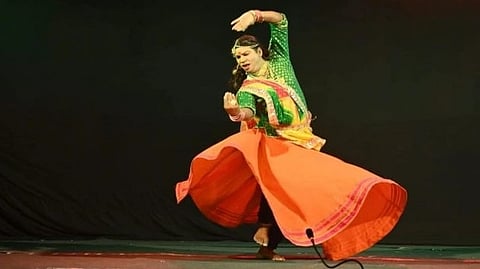
There was a time when Nat was known for something quite different. An artist of launda naach, the once immensely popular Bhojpuri folk theatre tradition in which men dress as women and perform female roles, he earned enough from performances to support his family. Today, invitations to perform at weddings and other events come only once or twice a year. For the rest of the time, he takes up daily-wage work to make ends meet.

Nat is among a generation of performers whose livelihoods have been pushed to the margins as launda naach loses its place in village life.
One of the best-known practitioners of the tradition was Padma Shri awardee Ramchandra Manjhi, a folk artist, playwright and social reformer who spent his life performing with the troupe of Bhikhari Thakur. Born in 1887, Thakur was a renowned poet, playwright and performer, often called the Shakespeare of Bhojpuri. His plays, including Bidesiya, Beti Bechwa and Bhai Virodh, addressed pressing social issues. Manjhi played female characters in these productions and drew crowds who stayed up all night to watch him perform.
When Manjhi spoke about the tradition in 2020, however, his concern was not about the performances he had once been part of, but what would become of the art after him. He died in September 2022, aged 97. The question he raised remains: will launda naach survive, and what will become of the livelihoods of its artists?
Among those who have reflected on the decline is Kumar Uday Singh, a native of Nalanda who now lives in Patna. He has performed launda naach for 35 years and is the subject of director Abhinav Thakur's film Lipstick Boy.
Singh says the decline is not simply about a dance form or a stage disappearing. It reflects a combination of factors, including shrinking livelihoods, changing tastes, a younger generation drifting away from the tradition and society's attitude towards its performers.
Despite its name, launda naach is more than a dance form. It is a folk theatre tradition popularised by Bhikhari Thakur, in which male actors played female characters while bringing social issues to the stage.
To understand its popularity, Singh says, it is important to consider how restrictive society was at the time. Purdah was deeply entrenched, and women appearing on public stages was largely unthinkable. Women who danced were mostly confined to the courts of kings and feudal lords. In this context, launda naach became an important source of entertainment for ordinary people, he explains.
The performances also addressed social issues that were rarely discussed openly. Thakur's plays dealt with subjects such as poor families selling their daughters, alcoholism and oppression.
Rajesh Prasad (35) from Gajrajganj in Bhojpur, comes from a family that has performed the art form for generations. He remembers the stories the troupes brought to the stage. “We used to bring stories of migration, poverty, family, social discrimination and relationships onto the stage,” he says.
Ram Ayodhya Bin (62) of Saraiya village, who has spent more than 23 years in the profession, recalls the crowds that gathered to watch the performances. He ran his own troupe and travelled from village to village. “Whenever the stage was up, people gathered through the night. There were days when invitations came from three or four groups at once!” he says.
At a time when entertainment options were limited, launda naach brought together storytelling, music and social commentary, drawing audiences from across villages.
Sonarika Ram (60) of Chhota Sasaram village, has watched these performances since childhood. “Earlier, when launda naach happened, the entire village would gather and watch. It was entertaining, and it carried stories and messages about society. People could see their own lives reflected on stage,” he says.
His favourite play was Bidesiya, the story of a husband who leaves home to find work and the wife left behind, waiting for his return. Whenever it was staged, the shamiana would be packed.
Those nights have become increasingly rare. The arrival of mobile phones and the internet, along with the growing popularity of Bhojpuri films and songs, has drawn audiences away from traditional performances. Sonarika says that performances at weddings and private events also gradually changed as new forms of entertainment became more accessible. “As artists and audiences gained access to new forms of entertainment, the popularity of launda naach started to decline,” he says.
The decline in performances has directly affected artists' earnings.
At the peak of its popularity, Rajesh says, his father's troupe, Azad Natya Kala Parishad, earned Rs 10,000 a day during the wedding season. Shatrudhan could earn Rs 2,000 to Rs 3,000 by performing at weddings through the night, while Ram Badan Manjhi (60) of Chhota Sasaram in Udwantnagar block, earned about Rs 1,000 a night.
Those earnings have dwindled. With fewer opportunities to perform, many artists have been forced to find other work to support their families. Shatrudhan, for instance, now earns about ₹500 a day as a labourer. Ram Badan also works as a labourer in his village, while Rajesh's father, Suresh Prasad, has moved to Punjab.
“Since the shows stopped, there was no work,” Suresh says over the phone from Ludhiana. “I now work here as a daily-wage labourer.”
Ram Badan says that although he no longer performs professionally, he has not given up the songs. Whenever he gets an opportunity, he still sings Thakur's compositions and dances in the traditional style. “The only difference is that I no longer perform before a stage; my audience is now the people of my own community,” he says.
Those who continue to perform professionally have not escaped the uncertainty either. Uday Singh now performs mostly at government events because, he says, people no longer invite his troupe. “I earn about Rs 1,000 per show, but I don't get shows every day.”
Ram Ayodhya, meanwhile, has disbanded his troupe. He now sings Thakur's songs with one or two fellow artists at Premchand Rangshala in Patna. “Invitations now are mostly for songs, not full plays,” he says. “During Navratri, if a village household calls, I go there too.”
The decline of launda naach is not simply a result of audiences losing interest. It also reflects changing market realities and competition from other forms of entertainment.
“Ordinary people can now hire orchestras and ladies' dance performers at lower prices. That is why we have to work as labourers to fill our stomachs,” says Shatrudhan.
Rajesh has adapted to this shift, albeit reluctantly. When bookings declined, he converted his father's troupe into a ladies' dance party. “This change is not a matter of personal preference, but a reflection of the changing times and the livelihood crisis confronting artists,” he says.
Whenever he gets an opportunity to perform on larger stages in places such as Patna, Rajesh joins his father and the group. These performances are also an attempt to keep the family's artistic legacy alive.
Beyond competition from newer forms of entertainment, performers also have to contend with social stigma. Uday Singh argues that audiences need to change their perceptions of the tradition. “People need to change their mentality towards our traditional dance. It is not vulgar; it is the pride of our society,” he says.
The prejudice Singh refers to is also reflected in the labels used to describe these performers. Ranjeet Parsad (45) a former panchayat samiti member from Harigaon, says society calls them by various names: nachaniya, mauga, natuwa and launda dance party. The terms reflect how performers are perceived and categorised in terms of gender and identity.
Referring to Shatrudhan's circumstances, Parsad says: “You can see for yourself the condition of a launda naach artist, he has to work as a labourer. Why would anyone from a wealthy family take up this work? It is people from lower castes who do it, and they do it out of compulsion. Today, because work has become scarce, that compulsion has turned into daily-wage labour.”
Given these circumstances, why would anyone want to continue performing launda naach? For the artists, it is more than a means of earning a living. It is an art form they have inherited and grown up with, and one they are reluctant to abandon. Even as performance opportunities dwindle, many continue to hope that the stage will find its audience again.
“We will never let this launda naach die,” Shatrudhan says.
But the survival of the tradition also depends on whether its performers can earn a living from it. Without regular opportunities to perform and greater acceptance of the art form, the future of launda naach remains uncertain. Its decline would mean not only the loss of a folk theatre tradition, but also the disappearance of a space in which generations of performers have brought stories of society to the stage.
[Wc/HP]
Suggested Reading:
Subscribe to our channels on YouTube and WhatsApp
Download our app on Play Store